
When I tell people, “Hey, please try Bovo! We work with some really good musicians to create and curate our data!” they often ask, “Is Bovo just a ChatGPT wrapper, like many other platforms?”
I always tell them, “NO! We own the data we produce.”
That’s why building Bovo and curating our data takes time. At Bovo, we don’t have an “our team built this in just two days” story. We’ve been putting our hearts into Bovo for a long time, building and refining it day after day.
All that time and care should make a difference in the music. For composers, we want that to mean parts that follow their musical intentions, feel natural for the instrument, and give them something useful to develop in their own projects.
Since people often ask about ChatGPT, I thought it would be interesting to compare their actual outputs. So today, I ran a small experiment using my personal ChatGPT Plus account with High selected to compare with Bovo Agent. I approached it as a composer or arranger working with a personal subscription and a local DAW, without relying on special access to additional models. I wanted to see how both tools would handle two requests that could fit into that workflow.
To keep myself from choosing only the results I liked, I followed one rule: each platform got just one attempt at each request.
The experiment
First, I asked for
“jazz, chill, smoothing piano” at 86 BPM.
Both tools received G-flat major, eight bars, 4/4, and the same chord progression:
Gbmaj7 | Ebm7 | Abm7 | Db Db7 | Gbmaj7 | Bbm7b5 | Eb7#5 | Ebm7
For the second test, I kept the progression, changed the tempo to 100 BPM, and requested
“strumming, active guitar.”
In ChatGPT, I included the musical settings in the message. In Bovo, I entered them directly into the agent alongside the short style prompt. So both received the same musical information through different interfaces.
The results
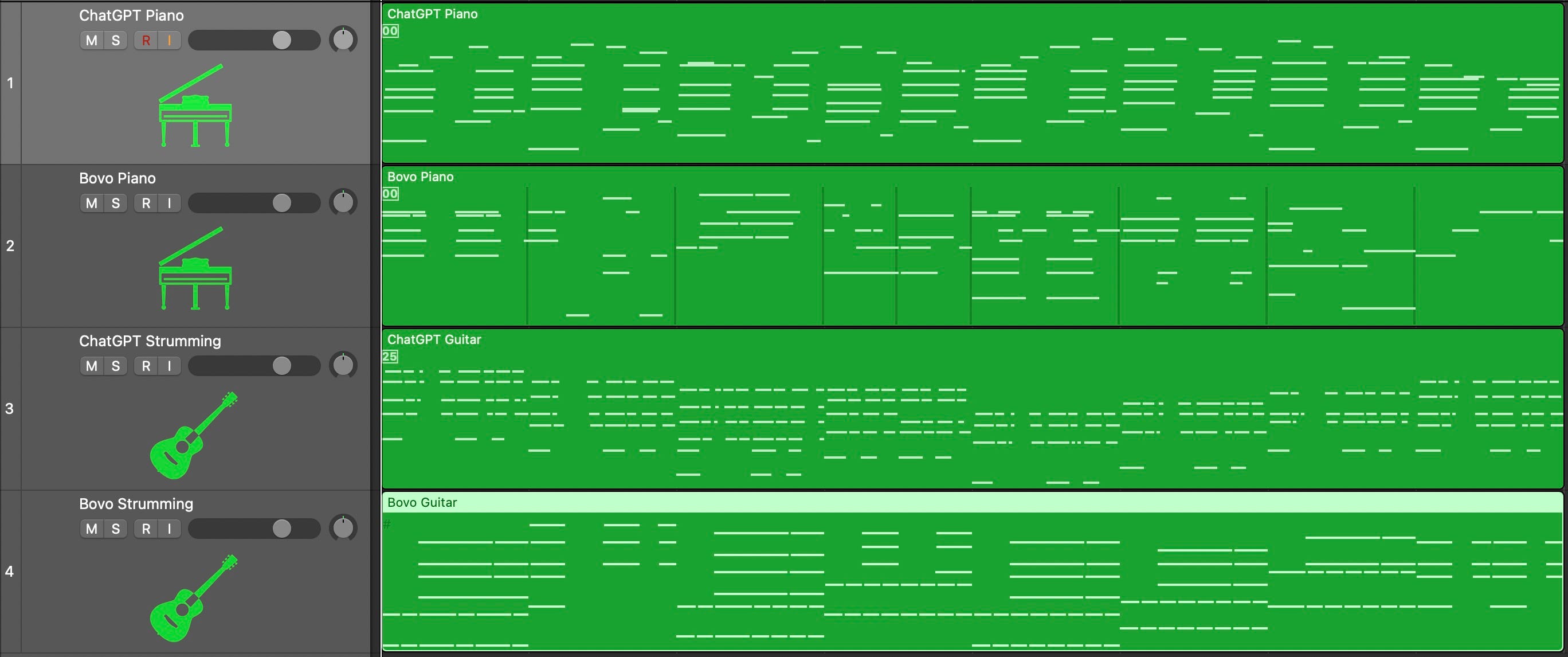
I bounced all four MIDI files individually in Logic Pro, using the same piano library for the piano pair and the same guitar library for the guitar pair. I then used the latest model, Gemini 4 Argon, to analyze the rendered audio. Here are its scores across the different areas, all out of 10.
Piano · Chill jazz · 86 BPM
Gemini 4 scores — out of 10
| Evaluation area | ChatGPT Plus (High) | Bovo Agent |
|---|---|---|
| Mood & chill factor | 6.5 | 9.5 |
| Expression & dynamics | 6.5 | 9.0 |
| Voicing & arrangement | 7.5 | 8.5 |
| OVERALL SCORE | 6.8 | 9.0 |
Guitar · Active strumming · 100 BPM
Gemini 4 scores — out of 10
| Evaluation area | ChatGPT Plus (High) | Bovo Agent |
|---|---|---|
| Strumming realism & articulation | 6.5 | 8.0 |
| Guitar voicing & fretboard logic | 7.5 | 8.5 |
| Expression & dynamics | 7.0 | 8.0 |
| OVERALL SCORE | 7.0 | 8.2 |
In addition, the waiting time was also quite different.
Recorded MIDI generation time
| MIDI request | ChatGPT Plus (High) | Bovo Agent |
|---|---|---|
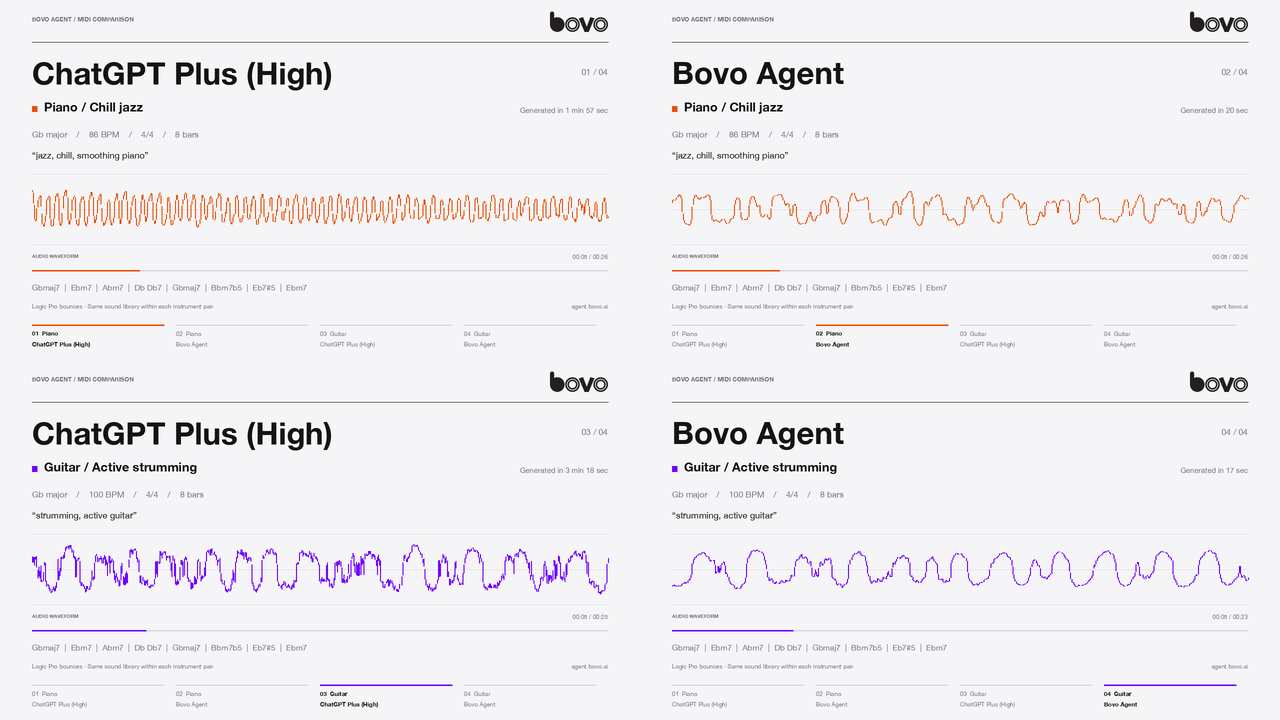
| Chill jazz piano | 1 min 57 sec | 20 sec |
| Active guitar strumming | 3 min 18 sec | 17 sec |
Listen here
In this video: Four MIDI outputs bounced in Logic Pro: ChatGPT Plus (High) piano, Bovo Agent piano, ChatGPT Plus (High) guitar strumming, and Bovo Agent guitar strumming. The piano pair uses the same piano library, and the guitar pair uses the same guitar library. The piano request is chill jazz at 86 BPM; the guitar request is active strumming at 100 BPM. Both use the G-flat-major, eight-bar, 4/4 setup and chord progression described above.
Is there a clear winner?
In these two comparisons, I think so, especially in our generation speed! But I also want to hear from more people about what we’re doing well and where we need to improve.
For me, a MIDI export is either useful for my project or it isn’t. There’s no middle ground.
The most frustrating thing about using an AI assistant is waiting a long time for a result I can’t use. At that point, I would have been better off doing everything myself.
Our goal has always been to produce useful results quickly. I’m glad to see that, in both comparisons, Bovo received higher overall scores from Gemini 4 and took 83% less time for piano and 91% less time for guitar to generate results.
Of course, these are only two examples, and Gemini’s scores are subjective. Still, they help explain why we believe Bovo is a better fit for composers who want AI to assist their workflow. Direct musical controls, quick generation, and editable parts give composers useful material to carry into their own projects.
We want Bovo to help composers spend less time on repetitive tasks and more time making the artistic decisions they care about. I hope you’ll try it with a project of your own and let us know what would make it more useful. Let’s create some music!
Try Bovo Agent today for free. https://agent.bovo.ai
Originally published on Medium on October 16, 2026.