
Meta’s Creative Audio team recently released Meta Open Sound, a collection of piano, nylon-string guitar, and steel-string guitar sample libraries under CC0. It also includes the Oculus Audio Pack, available separately under CC BY 4.0.
The release caught our team’s attention. Useful CC0 piano libraries can be hard to find, and we were curious to hear how these instruments would sound with MIDI generated by Bovo Agent.
The licensing also makes the instrument libraries interesting for musicians and developers, especially because CC0 allows commercial use, modification, and redistribution without mandatory attribution.
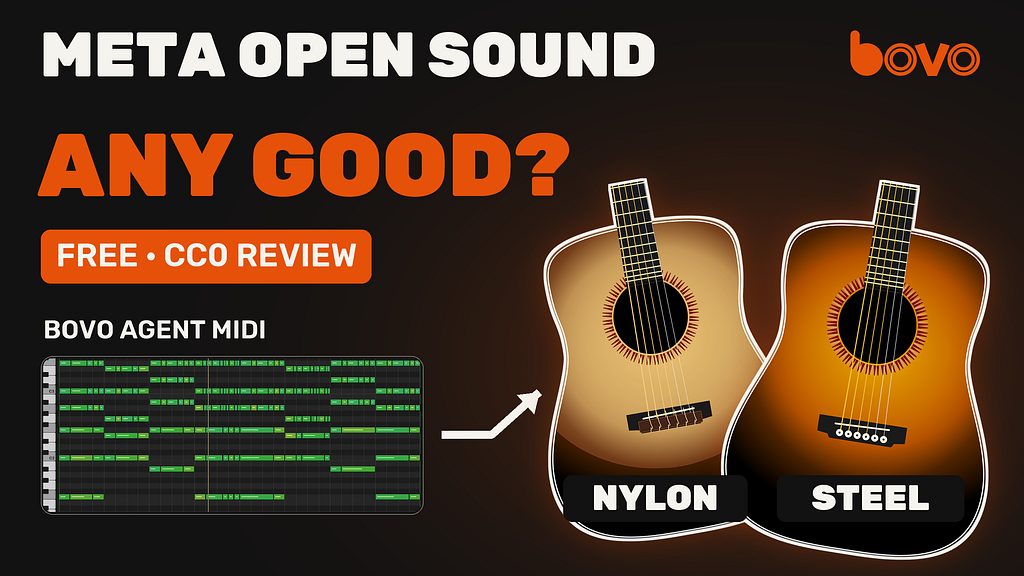
The Libraries
All three instrument libraries are relatively light-weighted, each coming in at under 1 GB. They use 24-bit, 48 kHz WAV samples, with four velocity layers per key for the piano and three dynamic layers for each guitar.
Of the three instruments, the piano surprised us most. Its mellow tone brings to mind a piano being played in a cozy room. I could imagine using it for intimate solo pieces, gentle accompaniment, or arrangements where the piano adds warmth without dominating the music.
Testing with Bovo Agent’s MIDI
For these tests, Bovo Agent supplied the MIDI :
the notes, timing, durations, and dynamics
and the sample libraries supplied the instrument sounds. The resulting performance depends on how those two parts work together.
I exported eight guitar loops from Bovo Agent: four strumming patterns and four fingerpicking patterns. These offer different ways to explore a guitar library. Strumming puts the chord’s overall balance and the timing of its attacks in focus. Fingerpicking gives individual notes more space, making their tone, sustain, and overlap easier to hear.
With no loudness normalization applied, the nylon-string guitar sounded noticeably quieter than the steel-string guitar in our setup, as I expected. That is worth keeping in mind when hearing the comparison: matching playback levels would make it easier to judge the tonal differences more closely.
These eight loops provide a starting point for exploring their response, longer arrangements would offer more opportunities to hear how they handle changing dynamics, textures, and phrasing.
Overall speaking, it would have been nicer if a broader range of articulations are included in these sound libraries, including techniques like muted strings, gliding sound etc.
From a Composer’s Perspective
Beyond testing individual loops, I’m interested in how these sounds could work within a complete arrangement.
Here’s what I made:
I began with a more interesting key for myself, the D# minor, and left Bovo Agent to select a proper chord progression for me. It did surprise me with something fun,
| E#m7b5 | A#9 | D#m7 | G#m9 C#13 |
To be honest this progression looks fancy on paper, but it’s really a variation of the basic ii-V-i progression plus a sequence.
I generated a few stems in Bovo Agent, including the melody, piano, guitar, bass, drum, and pad.
Inside Logic, I started with the piano using Meta Piano, because I think that’s the best part to create the vibe, then I thought using a vibraphone for the scalar melody would sound nice. After that I added the bass, and added the Meta Steel Guitar as an intro. I then thought about how to feature the Meta Nylon Guitar, so I faded away the piano, and faded in the Nylon Guitar at the end.
The rest was pretty straight forward, a drum pattern to play along the other parts, and two pads to thicken the voice a little bit.
Summary
Our first impressions of Meta Open Sound are encouraging. The piano stood out for its mellow tone, and both guitar libraries worked well with Bovo Agent’s strumming and fingerpicking patterns. Their compact size and CC0 availability make them appealing options to explore, with room for a wider expressive range through additional articulations.
Episode
When I first tried the sound libraries in Sforzando, I thought the guitar libraries were unusable because they sounded so bad. It was as if one of the two or three strings corresponding to a single note on a piano was out of tune, creating an ugly buzzing sound.
I initially decided to focus on the piano libraries instead, but then I thought, This can’t be right. So I listened to the individual audio samples, and they sounded perfectly clean. That led me to suspect that the problem was with how Sforzando was interpreting the .sfz files.
I tried debugging the issue with Codex, and it confirmed my suspicion: a single MIDI note was triggering multiple recordings of the same pitch simultaneously.
I fixed the issue, and the demos you’re hearing now were created using the corrected .sfz files.
Try Bovo Agent today: https://bovo.ai/music-agent