
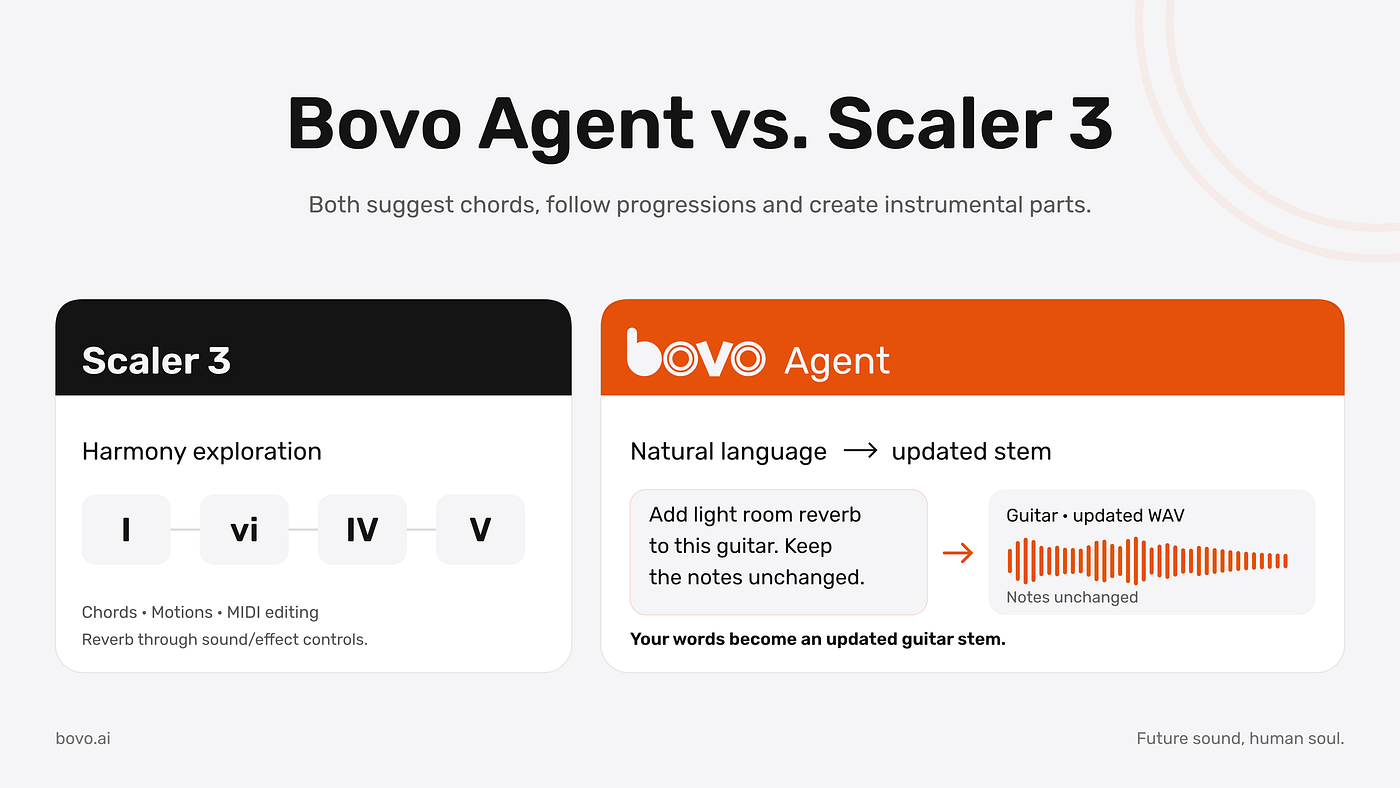
We’ve been asked how Bovo Agent differs from Scaler 3, so I decided to try the software myself.
Scaler 3 does a great job of bringing chords, MIDI, and arrangement ideas together. Its harmonic tools are particularly useful for exploring chord progressions, voicings, modulation, and musical patterns.
But after trying Scaler 3, I realized that the biggest difference isn’t necessarily what the two tools can produce. It’s how we get from a musical idea to an actual arrangement.
While Scaler 3 emphasizes exploring and developing musical possibilities, Bovo Agent focuses on translating musical intentions into instrumental parts through natural-language interaction.
Beyond Chord Progressions: Writing for Instruments
Both Bovo Agent and Scaler 3 can suggest chord progressions, follow existing harmony, generate instrumental parts, use included instrument sounds, apply effects, and export MIDI and audio.
But following a chord progression is only part of writing music.
A guitarist, pianist, bassist, and violinist can interpret exactly the same harmony in completely different ways. Each instrument has its own playing techniques, articulations, phrasing, and musical conventions.
This is where we’ve put much of our effort into Bovo Agent: generating idiomatic instrumental parts that reflect how musicians actually play.
For example, I can provide a chord progression and ask Bovo Agent to generate a relaxed fingerpicked acoustic guitar, an energetic strumming pattern, or a lyrical piano part with expressive phrasing.
I’m not simply asking for notes that fit the chords. I’m describing how I want the music to be played.
Our approach is also informed by how we train Bovo’s models. We commission recordings from professional musicians, compensate them for their performances, and obtain signed permission for AI training. These recordings provide examples of human instrumental playing for our models to learn from.
The goal is to create musical parts that are not only harmonically correct, but also make sense for the instruments performing them.
From Musical Ideas to Editable Stems
Bovo Agent generates individual instrumental stems using our native instrument sounds. Each part comes with rendered audio and editable MIDI, so I can work independently with the guitar, piano, bass, or other instruments in my arrangement.
This is particularly useful in my DAW workflow.
If I like the guitar performance, I can use the WAV directly, including its sound and processing. If I want to change the notes, adjust articulations, or try another sound library, I can import the MIDI instead.
Scaler 3 also provides instrument sounds, supports third-party instruments and effects, and exports MIDI and audio. These capabilities aren’t exclusive to Bovo.
What matters to me is being able to describe the performance I want, generate it, and immediately bring the result into my production workflow.
I can also ask Bovo Agent to revise an individual part without having to rebuild the entire arrangement.
Why I Prefer Starting with Words
As a composer, I often know what I want to hear before I know which software controls will get me there.
Perhaps I want the guitar to sound more intimate, the bass to play more actively, or a little more room around an instrument.
With Bovo Agent, I can simply describe those intentions, listen to the results, and continue refining the music.
For someone less familiar with production software, natural language makes music creation more approachable. For experienced musicians, it provides another way to communicate musical decisions without interrupting the creative process.
There is also a practical difference in accessibility.
Bovo Agent runs directly in the browser without requiring a dedicated application or plugin installation. On my Mac, Scaler 3.3.2 uses approximately 2.3 GB, including the application, plugin formats, content, and user data. That’s my measured setup, and of course, using Bovo in a browser still involves local storage for caches and downloaded files.
A Different Approach to Music Creation
I don’t see Scaler 3 and Bovo Agent as products that need to solve the same problem in exactly the same way.
Scaler 3 offers detailed control over harmony and musical patterns, making it a useful tool for exploring compositional possibilities.
With Bovo Agent, we’re trying to make the next step easier: turning a musical intention into an idiomatic, editable instrumental performance.
For my own workflow, that means spending less time figuring out how to make the software produce what I have in mind, and more time listening, making musical decisions, and shaping the final arrangement.
Ultimately, that’s what we want Bovo Agent to do: help musicians create music the way they think about music.