
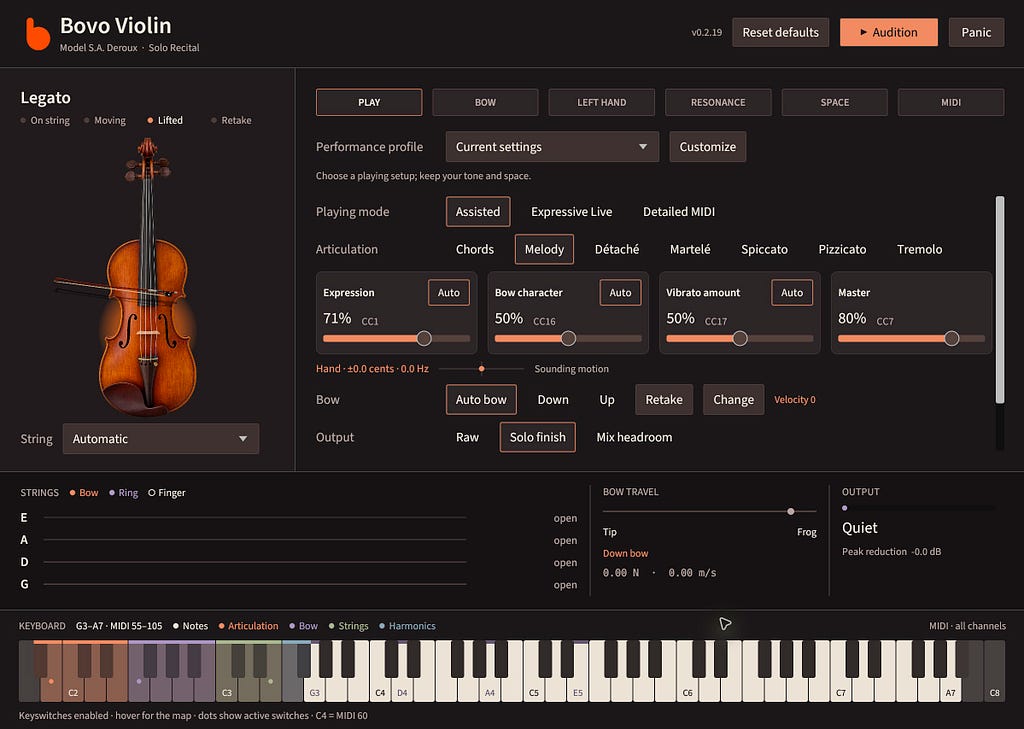
I have had a strong attachment to the violin ever since I started playing it at the age of six.
I wasn’t particularly serious about practicing at first. It wasn’t until my teenage years that I became more motivated and began to appreciate what the instrument could really do.
The violin is incredibly difficult to learn, even harder to play well, and almost impossible to truly master. After playing it for most of my life, I still discover things about it that I never fully understood.
And there’s a reason for that: even a single note on the violin is the result of an extraordinary number of interacting variables.
Why Is the Violin So Difficult to Play?
More Than 30 Parameters for a Single Note
Unlike a piano, where pressing a key produces a relatively predictable sound, playing the violin requires continuous control over how the sound is produced.
Even a single note can be affected by more than 30 performance parameters. Some of the most obvious include:
- Left-hand finger position and choice of finger
- Choice of string and position on the fingerboard
- Bow contact point (sul tasto, ordinario, sul ponticello)
- Bow pressure and speed
- Amount of bow hair in contact with the string
- Bow angle and placement
- Vibrato speed, width, and timing
And these parameters don’t operate independently. Changing the bow pressure, for example, may require adjusting the bow speed and contact point to maintain the desired sound.
This is why learning the violin can be so frustrating, but also incredibly rewarding.
I still remember how satisfying it felt when I first managed to produce a genuinely decent sound. It wasn’t a difficult passage or a beautiful melody. It was simply an open A string, where I was imagining myself being the concertmaster of my school’s orchestra.
Anyone who has seriously studied the violin will understand how much effort can go into producing just one beautiful note.
Building a Virtual Violin Is Even More Complicated
Modeling the Instrument, Not Just Its Sound
Everything I have mentioned so far concerns only the performance side of the violin.
But to build a physically modeled violin, we also need to recreate the instrument itself.
Unlike a conventional sample library, which plays back recordings of an instrument, physical modeling attempts to simulate how the instrument produces sound through mathematics and physics.
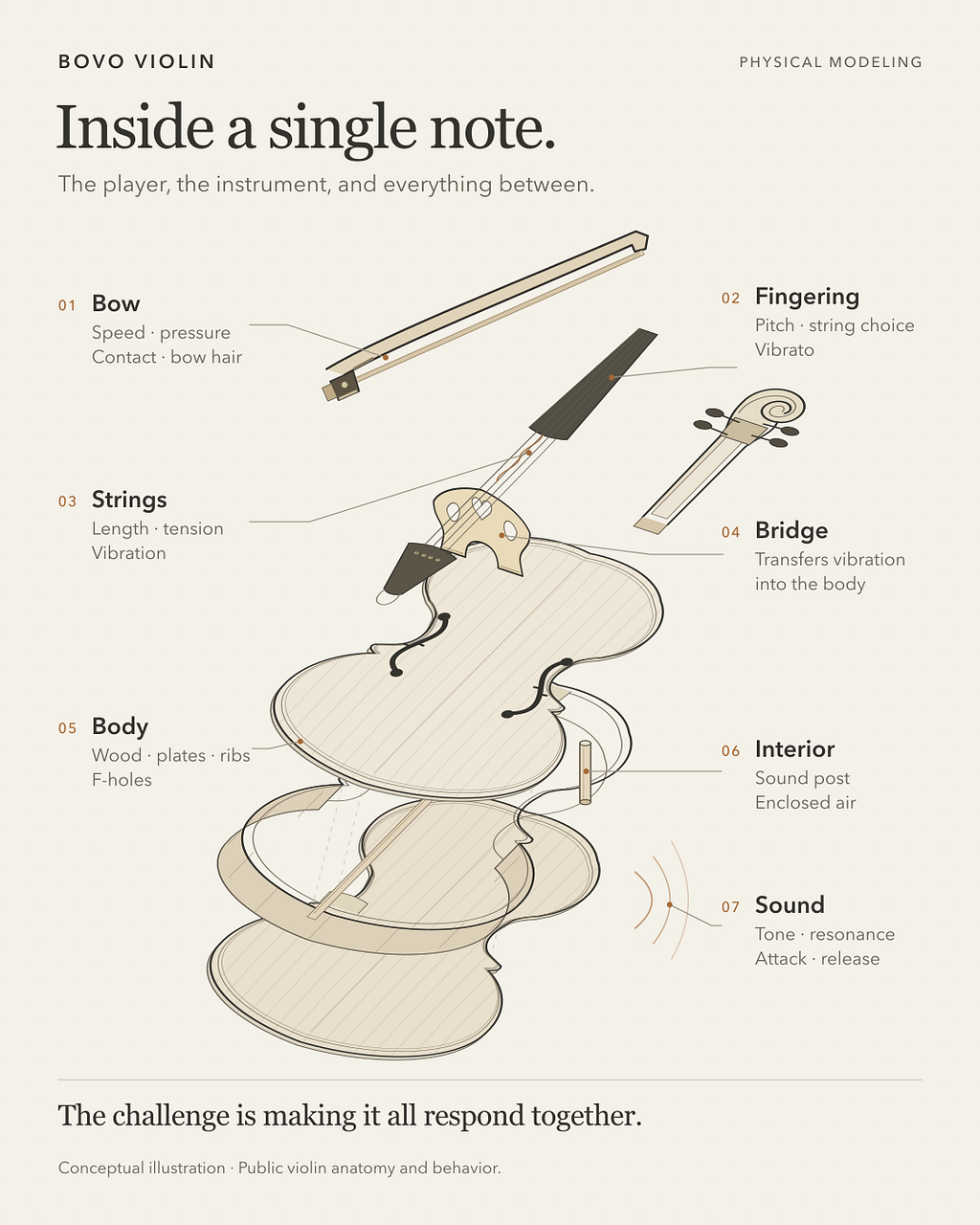
That means we need to account for components such as:
- The wood: Its physical properties affect how the body vibrates and resonates.
- The strings: Their tension, mass, stiffness, and damping influence how they respond to the bow.
- The f-holes: Their geometry contributes to the acoustic response of the violin.
- The soundpost: It helps transfer and couple vibrations between the top and back plates.
- The bridge: It transfers vibrations from the strings into the body.
- The bow: Its interaction with the strings is fundamental to producing the characteristic sound of a violin.
But modeling these components individually is only the beginning.
The real difficulty is understanding how they interact. Every adjustment to one component can affect the behavior of the entire instrument. A violin is an interconnected acoustic system, and recreating that system computationally is an enormous challenge.
Based on My Own Violin
For Bovo Violin, I wanted to start with something deeply personal: the violin I still play regularly.
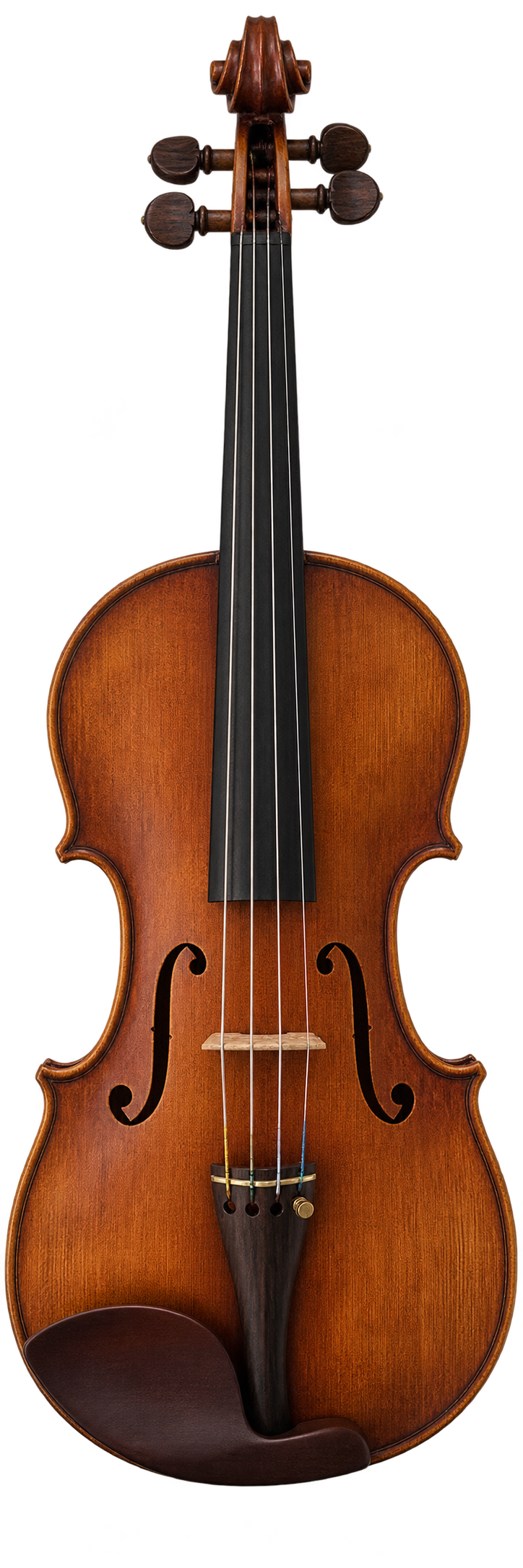
Our model is based on my own French violin, made by S. A. Deroux. Having played this instrument for years, I have developed a strong familiarity with its tone, response, and character.
This gives me a valuable reference when developing and testing the model. I am not simply trying to create a generic violin sound. I am trying to reproduce the behavior and musical qualities of an instrument I know intimately.
Of course, knowing how a violin sounds is very different from understanding exactly why it sounds that way.
Translating its physical characteristics into mathematical relationships is extremely challenging. Even when the individual components appear to behave correctly, their combined response may still sound unnatural.
Sometimes a tiny adjustment improves one aspect of the sound while unexpectedly affecting another. Much of the development involves repeatedly testing, listening, analyzing, and refining the model, and most importantly, comparing to myself playing the same passage in real life.
Why We Built Bovo Violin
Realistic Sound Should Be More Accessible
As a composer, I have spent years working with virtual instruments and sample libraries. Although there are excellent products available, producing a convincing violin performance can still be difficult and expensive.
I also know how challenging it is to earn a living through composition.
Securing commissions isn’t easy, and it’s remarkable how quickly the money we earn can disappear into equipment, software, and sample libraries. Spending several hundred dollars on a single virtual instrument is simply not realistic for everyone.
This became one of my motivations for developing Bovo Violin.
I wanted to build an expressive, realistic violin that composers and musicians could actually afford and use.
Not just another library of beautiful recordings, but an instrument that gives musicians meaningful control over how every note is performed.
Almost 100 Parameters, Over 1,600 Numerical Values
As development progressed, the complexity became increasingly apparent.
Bovo Violin now incorporates almost 100 parameters involved in performing a single note, along with more than a thousand numerical values used to define its physical and acoustic behavior.
These numbers are not simply there to make the technology sound impressive. In fact, more parameters do not necessarily mean better sound.
What matters is how they interact.
While developing Bovo Violin, I had to make decision on what parameters to automate, and what is left for users to fine tune the instrument.
The challenge isn’t simply making a computer produce something that sounds like a violin. It’s making the instrument behave like a violin.
Bringing the Instrument to Life
Technology in Service of Musical Expression
After spending so many years studying the violin, I find it fascinating that I am now trying to recreate its behavior through physics, mathematics, and code.
But ultimately, I don’t think a virtual instrument should be judged by how many parameters or algorithms it contains.
The real question is whether it allows musicians to express what they have in mind.
Can I shape a phrase naturally? Can I control the tone color, dynamics, bowing, and vibrato the way I would on a real violin? Can I make the instrument respond to my musical intentions?
These are the questions guiding our development.
I don’t expect a virtual instrument to replace the experience of playing a real violin. But I believe physical modeling can bring us much closer to capturing the expressive possibilities of the instrument, while making them available to more composers and musicians.
In a way, this journey brings me back to when I was a child, struggling to produce a beautiful sound on an open A string.
More than three decades later, I’m still trying to produce that same beautiful sound. Only now, I’m doing it through mathematics and code.
Bovo Violin, like many of our upcoming releases, is far from perfect. There is still much to refine, remodel, and improve to better fit musicians’ workflows and creative needs.
We would love to hear your feedback, suggestions, and ideas as we continue developing and improving our instruments. Your input will help us make them better.
The AU/VST is available to download now at https://bovo.ai/instruments/violin
Thank you for being part of this journey.
//
Visit Bovo and learn more about us: https://www.bovo.ai